

#007 — React Fragment + WebRTC
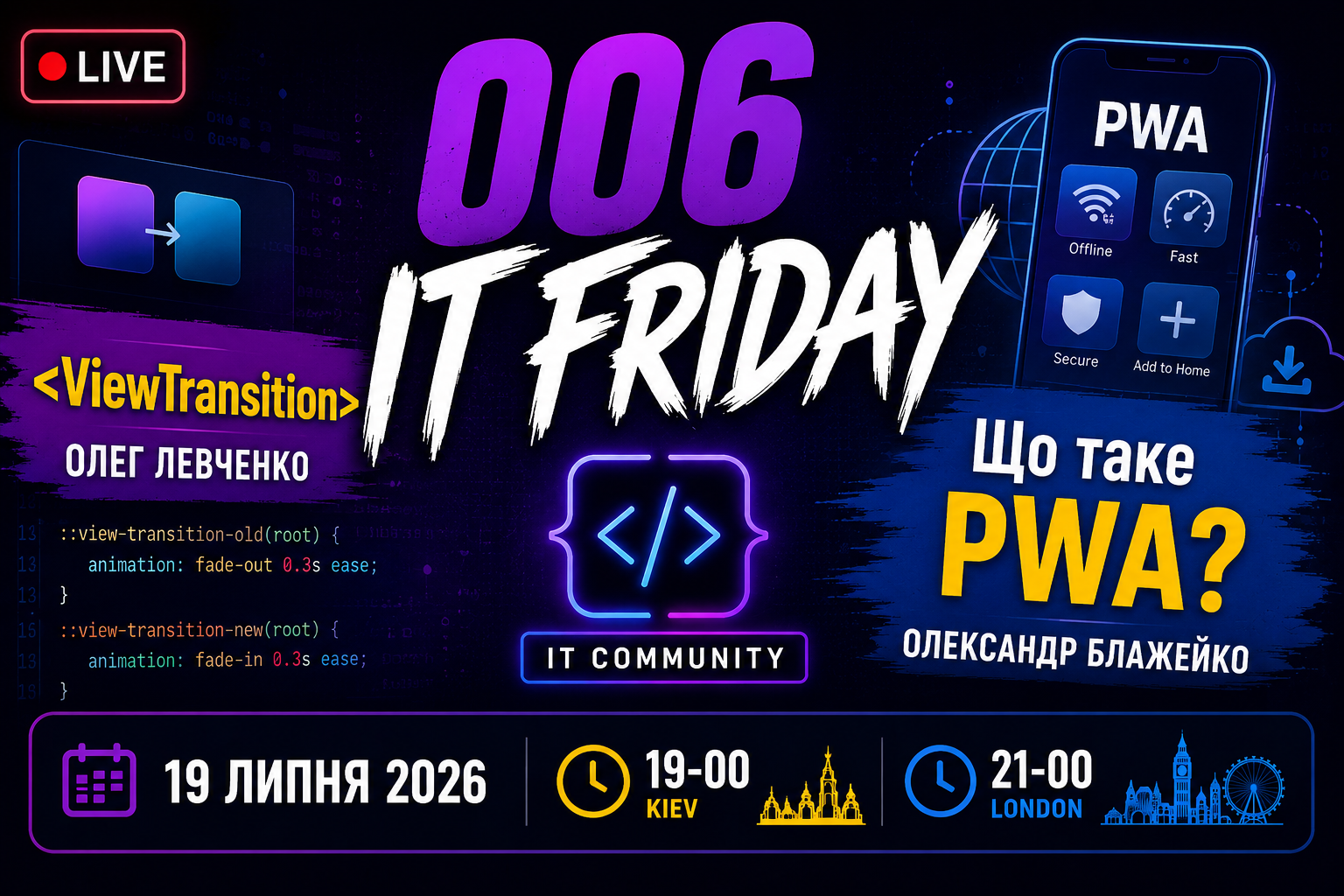
Date: June 26, 2026 | 19:00 London / 21:00 Kyiv
Format: Two talks · ~60 min
Guest: Oleksandr Blazheiko
YouTube: https://youtube.com/live/leT3mUEmIqA
Participants
Oleh Levchenko — Senior Full Stack JavaScript Developer (React / Node.js / AWS)
The AA · Cardiff, UK
YouTube @zloyleva · itfriday.community
Oleksandr Blazheiko — Software Development Engineer · Fullstack, 7+ years of experience
Ukraine
LinkedIn · itvibe.party
Key Takeaways
Talk 1 — React Fragment · Oleh Levchenko
<></>compiles toReact.Fragment— not just syntactic sugar, but a full component; adds no DOM node, which is critical for Flexbox/Grid layouts and valid HTML (e.g.<tr>inside<tbody>)- Shorthand vs explicit:
<></>is convenient but accepts no props; forkeyin.map()always use<Fragment key={...}>— without it React can't track elements when order changes, and state becomes tied to position rather than identity - State preservation gotcha:
<><Child /></>and<Child />are the same React tree; but<><><Child /></></>→<Child />are different — an extra Fragment level resets the child component's state - FragmentInstance (Canary):
refon<Fragment>returns not a DOM node but aFragmentInstanceobject — no DOM wrapper, yet with methods for three tasks - Events without wrapper:
fragmentRef.current.addEventListener('click', handler)— one listener targeting all first-level DOM children;removeEventListeneranddispatchEventare also supported - Focus management:
focus()finds the first focusable element depth-first;focusLast()— the last one;blur()removes focus if it's within the fragment — useful for accessibility when opening modals observeUsing(observer): attaches anIntersectionObserver,ResizeObserver, orMutationObserverto all first-level DOM children in one call;unobserveUsingfor cleanup — no wrapper div needed
Talk 2 — WebRTC · Oleksandr Blazheiko
- WebRTC (Web Real-Time Communication) — open W3C/IETF standard since 2021: audio, video, and arbitrary data directly between browsers (peer-to-peer) without plugins or media relay servers
- Two phases: first, peers "meet" through a Signaling server and STUN (SDP/ICE exchange + public address discovery), then media and data travel directly between devices — servers are no longer in the media path
- ICE / STUN / TURN: ICE tries all possible network paths; STUN tells a device its public address; TURN is the fallback relay when direct P2P is impossible (Symmetric NAT)
- When STUN is enough: Full Cone, Restricted Cone, Port-Restricted NAT — hole punching opens a direct channel; Symmetric NAT on both sides → TURN kicks in as a relay
- Three core APIs:
getUserMedia()— camera/microphone access;RTCPeerConnection— the heart of WebRTC: connection, NAT traversal, encryption;RTCDataChannel— bidirectional channel for text, files, game state - Signaling: WebRTC doesn't dictate the protocol — WebSocket, HTTP, SIP, or anything works; Peer A sends an offer (SDP), Peer B responds with an answer, then both exchange ICE candidates
- Encryption is mandatory: DTLS — handshake directly in the P2P channel, verifies certificates and negotiates keys; SRTP encrypts every media packet using those keys; there is no unencrypted mode
- Debugging in Chrome:
chrome://webrtc-internals— live stats (bitrate, packet loss, jitter, RTT), ICE candidate state, full SDP offer/answer, export to file;getStats()API for custom monitoring - Challenges: P2P scales poorly to large groups → SFU architecture (media servers); TURN servers are costly under symmetric NAT; compatibility quirks between implementations
Timecodes
To be added after the stream.